


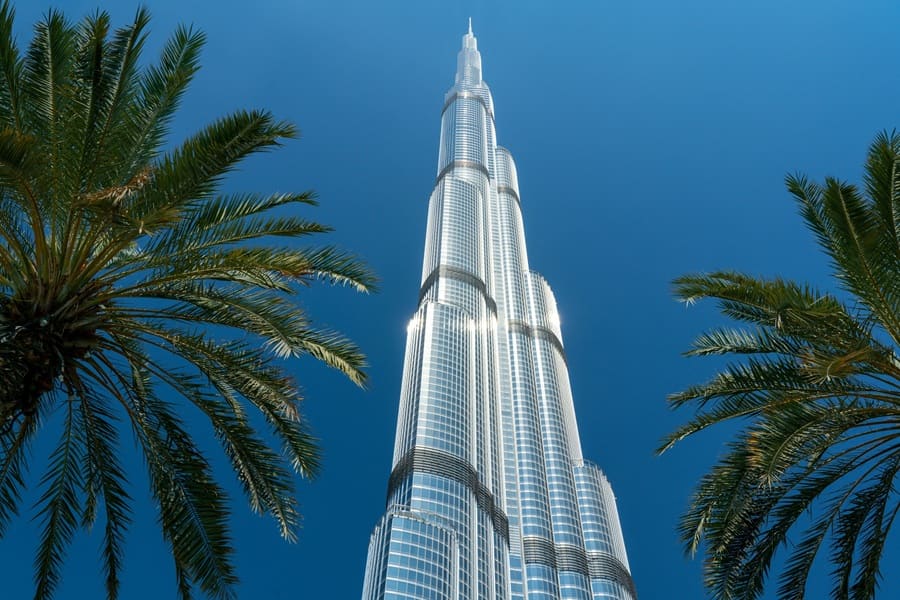
Dubai’s skyline is world-famous for its record-breaking towers that captivate both sightseers and real estate enthusiasts. In fact, visiting these engineering marvels is among the top things to do in Dubai for any traveler, as they are iconic Dubai tourist locations in their own right. Beyond their wow-factor for tourists, many of these skyscrapers also represent prime investment opportunities – boasting luxury apartments, hotels, and offices that attract global investors. This casual guide will rank and highlight some of Dubai’s best towers, detailing their significance, location, unique features, and why they appeal to visitors and property investors alike. From the world’s tallest building to twisting architectural wonders, let’s explore these sky-high icons of Dubai.
Burj Khalifa – The World’s Tallest Skyscraper
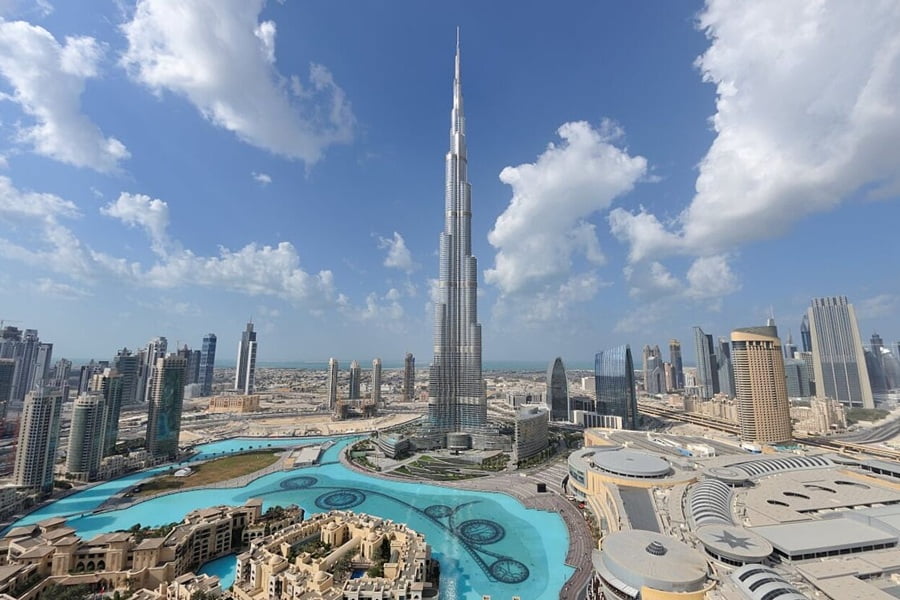
Burj Khalifa dominates the Dubai skyline as the tallest building on the planet.
No list of Dubai towers could start with anything other than Burj Khalifa, the pinnacle of Dubai’s ambitions. Soaring to 828 meters (2,717 ft) with over 160 floors, this megatall skyscraper has been the world’s tallest building since 2009. To put it in perspective, the Burj Khalifa stands about three times the height of the Eiffel Tower, an “828m tall” giant that attracts around 17 million visitors per year. It’s not just tall – it’s sensationally popular, generating hundreds of millions of dollars annually in ticket sales from its observation decks.
Location & Features: Burj Khalifa is the centerpiece of Downtown Dubai, anchored beside the Dubai Mall and the Burj Lake (home to the Dubai Fountain show). Tourists flock to its “At The Top” observation decks on the 124th/125th floors and the premium SKY deck on the 148th floor (555 meters up) for unmatched panoramic views. A visitor can rocket up nearly 800m in under a minute by elevator – an ear-popping thrill in itself. From the top, you’ll witness the city, desert, and even the ocean stretching to the horizon. Pro tip: Aim for late afternoon to catch daylight, sunset, and the glittering night view all in one visit (peak times are around 4–7pm in winter).
Tourist Appeal: Simply put, Burj Khalifa is a must-see. It was recently named the world’s most popular landmark, beating out sites like the Taj Mahal, thanks to its huge visitor numbers. Watching the sunset from its observation deck, or dining at the Atmosphere restaurant on the 122nd floor, ranks among the essential experiences in Dubai. Indeed, visiting Burj Khalifa is often considered one of the essential things to do in Dubai for first-timers. Don’t miss the evening fountain show at its base – a free spectacle where water jets dance in sync with music, framed by the towering silhouette above.
Investment Angle: Burj Khalifa also symbolizes Dubai’s luxury property market. It contains high-end corporate suites, the Armani Hotel, and exclusive residences. Owning an apartment here is an ultimate status symbol – some units sold for tens of millions of dirhams. For investors, the tower’s global fame and downtown location have translated into strong property values and rental demand. It’s part of a larger 2 sq.km development designed to boost tourism and international recognition for Dubai. In fact, the project was conceived to diversify Dubai’s economy into tourism and real estate – and it succeeded, putting Dubai “on the map with something really sensational”. Whether you’re a visitor snapping selfies or an investor eyeing prime real estate, Burj Khalifa delivers on its promise as Dubai’s most iconic tower.
Princess Tower – A Record-Breaking Residential High-Rise
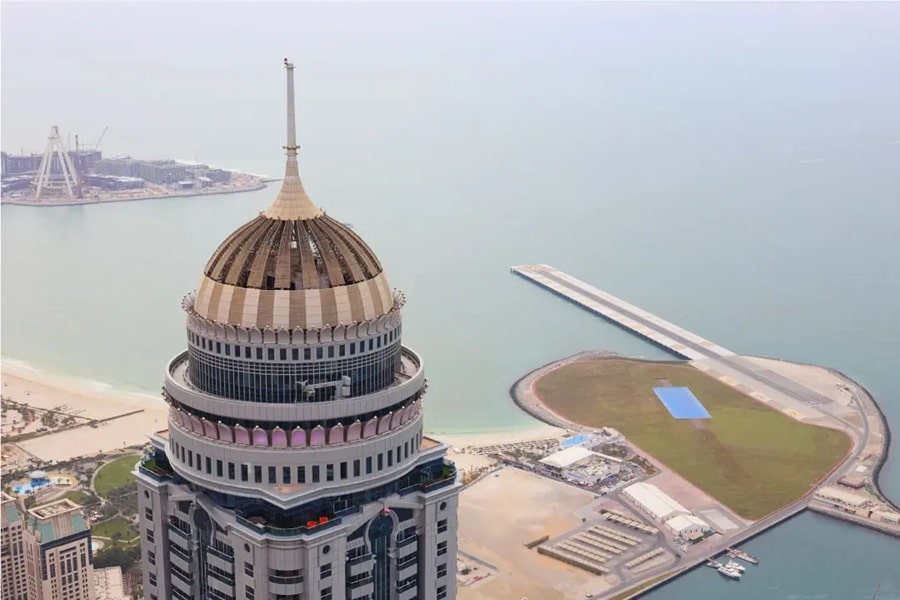
Towering above the Dubai Marina district, the Princess Tower once held the title of the world’s tallest residential building at 413.4 m (1,356 ft) with 101 storeysguinnessworldrecords.com. This gleaming skyscraper, opened in 2012, is a dominant feature of the Marina skyline – its crown resembling a regal tiara lit up at night. Even years later, Princess Tower remains one of the top three tallest buildings in Dubai, surpassed only by Burj Khalifa and the under-completion Marina 101.
Location & Significance: Situated in Dubai Marina, Princess Tower is surrounded by other supertalls, but its record-breaking height and distinctive ornamented roof make it stand out. For a few years, it was the skyscraper celebrity in the Marina, earning a Guinness World Record as the tallest all-residential tower in 2012guinnessworldrecords.com. (It held that crown until 432 Park Avenue in New York edged it out in 2015.) To this day it remains an engineering marvel, and a symbol of Dubai’s high-rise luxury living boom in the 2000s.
Features for Residents: This 107-floor development houses 763 apartments ranging from one-bedroom units to opulent penthouses. It’s essentially a vertical neighborhood. Residents enjoy indoor and outdoor pools, gyms, saunas, a game hall, children’s play areas, and even a private observation deck on the 97th floor. (Yes, residents have their own sky lounge with WiFi to soak in views of the Palm Jumeirah and Arabian Gulf!). The building’s amenities make it almost resort-like – ideal for affluent professionals and families.
Tourist Perspective: As a traveler, you can’t freely go inside Princess Tower (it’s apartments, not a tourist site), but it’s worth seeing from the outside as part of the Marina panorama. Strolling along Marina Walk or taking a boat tour through the Marina’s waterways, you’ll get fantastic views of Princess Tower and its neighboring giants. It’s especially photogenic at dusk when the skyline lights up. If you’re adventurous, you could ride to the Cloud 9 skydiving dropzone nearby – skydivers often get a unique view of the tower on the way down! Even from the public beaches of Jumeirah Beach Residence (JBR) or The Palm island, you can spot Princess Tower punctuating the skyline. It’s a Dubai tourist location in the sense that it defines the iconic silhouette of the city’s modern coastal development.
Investment Appeal: Princess Tower’s reputation and Marina address have kept it attractive to property investors. The Dubai Marina area is highly sought after by expats and investors for its waterfront lifestyle. Units in Princess Tower have seen value appreciation over time, and rental yields remain solid given the tower’s prestige and amenities. The fact that it was developed by Tameer and completed during a challenging time (post-2008 crisis) yet delivered in 2012 gives investors confidence in the long-term viability of Dubai real estate. Plus, the tower’s sheer height offers bragging rights – owning on the 90th floor of what was the world’s tallest residence has an allure of its own. Overall, Princess Tower represents Dubai’s blend of luxury living and skyscraper innovation, appealing to those who want to literally live among the clouds.
Marina 101 – Dubai Marina’s Sleeping Giant
Over in Dubai Marina, another behemoth reaches for the sky: Marina 101. This 101-storey skyscraper, about 425 m (1,394 ft) tall, is set to become Dubai’s second tallest building after Burj Khalifa. Marina 101’s story is the stuff of development legend – launched in 2005 during the real estate boom, it promised to be a shining star in the skyline, but faced lengthy delays. As of 2025, it’s finally nearing completion and handover after almost two decades. Investors who bought units here have been eagerly (and patiently) awaiting this “sleeping giant” to awaken.
Location & Design: Marina 101 proudly stands in Dubai Marina near the Trident Towers and not far from Princess Tower. Its design is a bit more conventional (no twists or sail shapes), but it makes up for that with sheer scale – when fully opened, it will dwarf the surrounding towers except Princess Tower which it slightly surpasses. The tower’s crown features an illuminated ornamental peak that, once lit, will further brighten the Marina skyline at night.
Current Status: For years, Marina 101 has been essentially complete on the outside but unopened. Construction hit 97% completion before stalling due to financial hurdles. The project went through developer issues, and even an auction of its hotel component. Originally the first 33 floors were slated to host a Hard Rock Hotel – imagine a rock ’n’ roll themed luxury hotel with guitar memorabilia in the lobby! – but that plan was shelved and the hotel floors were auctioned off to new owners. Now, thanks to intervention by regulators (RERA) and renewed investment, the tower is poised to finally welcome residents and guests.
For Tourists: Once operational, Marina 101 will likely house a hotel (yet to be branded) in its lower section and residential apartments above. Tourists might soon be able to book a stay in one of the highest hotel rooms in Dubai Marina or visit a sky bar/restaurant with sweeping views (one can hope the new operators add such an attraction on a top floor!). Even now, Marina 101 is an impressive sight from outside – you can view it best from JBR Beach or Bluewaters Island for a full skyline photo, or up close on foot in the Marina. It’s a conversation starter to point out: “See that huge, almost-finished tower? That’s Marina 101, the second tallest in Dubai.” The saga behind it makes for an interesting Dubai anecdote.
For Investors: Marina 101’s completion is great news to those who invested in its luxury apartments years ago. Many owners paid millions of dirhams for units, betting on the tower’s prime location and height. With handovers expected in 2025, these investors may finally reap the rewards. Market listings show 1-bedroom units around AED 1.5M and 2-bedrooms around AED 2.7M even before the building officially opens. Once the hotel portion is up and running and the tower is fully functional, property values could climb further – the logic being that a completed landmark draws demand. As one long-time investor put it, he expects prices to “increase once it opens,” and he plans to hold at least one unit long-term to benefit from that uptick. In short, Marina 101 represents both a cautionary tale and a beacon of hope: despite delays, Dubai’s real estate dreams eventually materialize – and those who hold on patiently might just find it worth the wait.
Cayan Tower – The Twisting Wonder of Dubai Marina
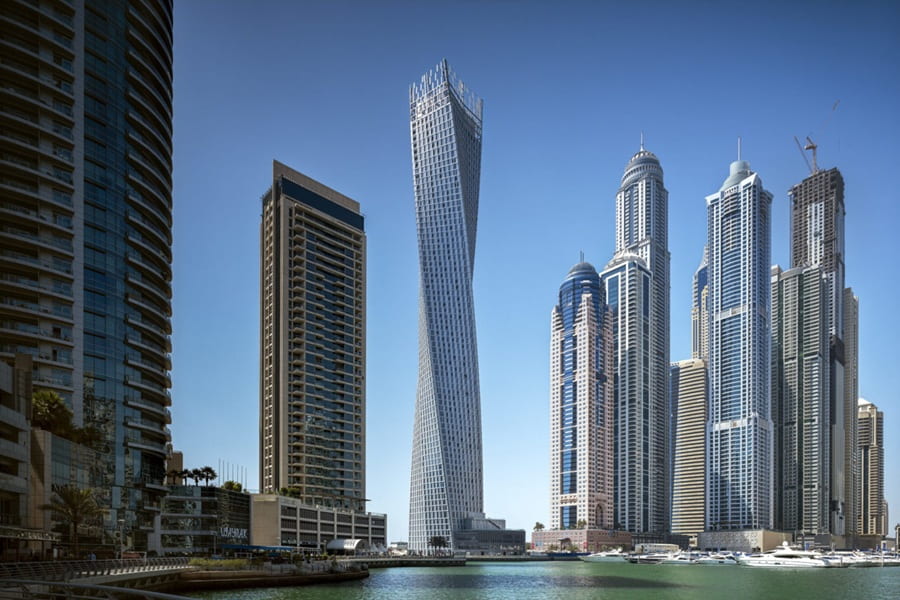
In a city full of unique architecture, Cayan Tower still manages to make everyone do a double-take. This 307 m (1,007 ft) tall residential tower in Dubai Marina is famous for its distinctive 90-degree twist from base to top. Imagine a skyscraper that corkscrews as it rises – by the time you reach the top floor, you’re facing a completely different direction than at ground level! When it opened in 2013 (originally known as “Infinity Tower”), Cayan Tower was the world’s tallest twisting tower, a title it held for several years.
Architecture & Design: Cayan Tower’s helix-like design isn’t just for show – it was conceived to maximize waterfront views for its residents. Each floor is rotated 1.2 degrees relative to the one below, resulting in the full 90° twist across its 75 stories. This means apartments enjoy panoramic vistas of the Marina, the Palm Jumeirah, and the Arabian Gulf that would be obstructed in a traditional straight tower. The tower’s architects (Skidmore, Owings & Merrill – the same firm behind Burj Khalifa) managed to achieve this dramatic effect with ingenious engineering, all while keeping floor plans uniform for practicality. The outcome is both an artistic statement and a commercial success – it looks like a giant sculpture, but functions as a high-end condo building with 495 units.
Tourist Appeal: Cayan Tower has no observation deck or public interior space; its beauty is in the exterior. Tourists love photographing it – it’s arguably one of the most Instagrammed buildings in Dubai Marina. A popular vantage point is from Marina Promenade or the Bridge near Marina Mall, where you can gaze up at the tower’s mesmerizing twist alongside yachts in the marina. At certain angles, especially near sunset, the building reflects the golden light and you can really appreciate its spiral form against the sky. It’s also stunning at night with strategic lighting accentuating the twist. If you’re on a boat tour or a dinner cruise, keep your camera ready as you pass Cayan Tower – it’s a highlight of the Marina skyline tour. And for architecture buffs, simply seeing it up close is a thrill; you might even find yourself tilting your head trying to follow the twist upwards!
Living & Investment: For investors and residents, Cayan Tower offers luxury living with a twist (pun intended). The apartments have floor-to-ceiling windows to capitalize on those views, and many have balconies that overlook the Palm or the Marina. Being a purely residential tower, it’s filled with a mix of expat homeowners and tenants who enjoy the Marina lifestyle. When it launched, units sold out quickly, aided by the tower’s architectural fame and the fact that repeating floor layouts made it easier to market (every apartment was unique in view, but not in layout, which “streamlined selling” the 495 condos). Property investors were drawn to Cayan for its one-of-a-kind design – a conversation piece that also promised solid rental yields given demand from tenants wanting that address. Today, Cayan Tower apartments remain premium, often commanding slightly higher prices than similar Marina towers without a twist. It’s a fine example of how innovative design can drive real estate value. Beyond the financials, owning a property in Cayan Tower is like owning a piece of modern art on the Dubai skyline – and that’s a priceless allure for many.
Burj Al Arab – The Sail-Shaped Luxury Hotel
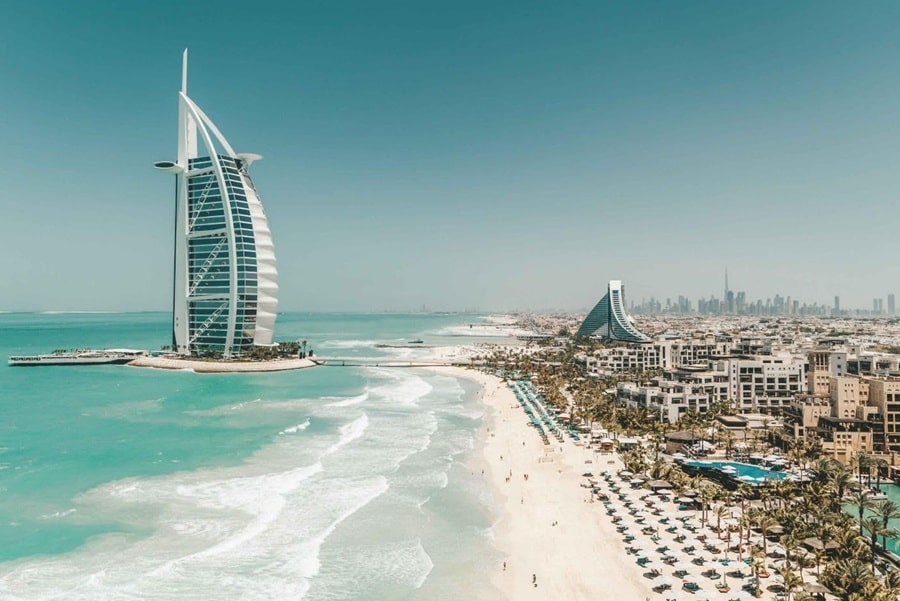
The Burj Al Arab stands on its own island, its iconic “sail” design a symbol of Dubai’s luxury.
Not all of Dubai’s famous towers are scrapers of the sky – some are symbols of luxury and engineering in other ways. Burj Al Arab is a prime example. Sitting in the Gulf waters on its own man-made island, this 321 m (1,053 ft) tall hotel is designed to resemble a billowing sail of a ship. Ever since it opened in 1999, Burj Al Arab has been Dubai’s emblem of opulence, often touted (unofficially) as “the world’s only 7-star hotel” – a tongue-in-cheek moniker born from its over-the-top luxury.
Architecture & Luxury: Burj Al Arab’s unique silhouette – a white “dhow sail” shape – has made it one of the most recognizable hotel buildings on Earth. It stands on an artificial island 280m offshore from Jumeirah Beach, connected by a private bridge. This positioning was deliberate to ensure its shadow doesn’t fall on the beach (talk about attention to detail!). The hotel’s interior is no less impressive: a soaring atrium nearly 180 m high, lavish use of gold leaf (nearly 1,790 square meters of 24-karat gold adorn the interiors!), marble, and bespoke furnishings. It’s a suite-only hotel – all 202 accommodations are duplex suites with extravagant decor and panoramic views. The service is legendary, featuring personal butlers and an optional chauffeur-driven Rolls-Royce or helicopter transfer. Little wonder a British journalist, awestruck by its grandeur, coined the term “7-star hotel” to describe it (though officially it’s “just” a 5-star deluxe property).
Visiting Burj Al Arab: While the hotel was historically for guests only, tourists can now experience a taste of its luxury through afternoon tea reservations, dining, or the “Inside Burj Al Arab” tour. Booking high tea at the Skyview Bar (27th floor) or dinner at the underwater-themed Al Mahara restaurant will grant you entry to explore the sumptuous lobby. A more casual way to admire Burj Al Arab is from outside. The adjacent public beach and the grounds of Madinat Jumeirah souk offer postcard-perfect views, especially at sunset when the hotel’s exterior is bathed in orange and pink hues. A fun fact: the hotel’s helipad, perched near the roof at 210 m high, has hosted wild stunts – from tennis matches (Andre Agassi famously rallied up there) to a Formula 1 car pit-stop and even a boxing ring event. Although you likely won’t get onto the helipad, just knowing it’s there adds to the mystique!
Crucially for families, Burj Al Arab is adjacent to one of the best water parks in Dubai , the Wild Wadi Waterpark. In fact, Wild Wadi literally sits in the sail-shaped hotel’s shadow, offering 30 rides and attractions with the Burj as a backdrop. Guests of the hotel enjoy free access to Wild Wadi, but anyone can visit the water park for a day of fun. It’s a perfect combo: spend your morning relaxing on the beach gazing at Burj Al Arab, then cool off on waterslides next door.
Investment Perspective: While you can’t “invest” in Burj Al Arab in the traditional real estate sense (it’s not subdivided into condos), it has been an investment in Dubai’s tourism brand. The Jumeirah Group, which operates the hotel, has leveraged its cachet to bolster Dubai’s image as a luxury destination. The mere presence of such an ultra-luxurious icon has a halo effect on surrounding property – nearby luxury hotels, resorts, and even residential villas in Jumeirah have benefitted from the area’s prestige. For high-net-worth investors or companies, hosting events or clients at Burj Al Arab is a statement of extravagance. In a way, Burj Al Arab demonstrates how visionary architecture can transform a city’s global profile – a lesson not lost on Dubai’s strategists. It remains a trophy asset of the emirate, and a must-see landmark for visitors, even if just from the outside. If you are planning a trip, consider budgeting a special experience here (yes, it will cost a pretty penny, but many say it’s worth every dirham for the memories). After all, how often do you get to step inside a “seven-star” icon?
Jumeirah Emirates Towers – Twin Icons of Sheikh Zayed Road
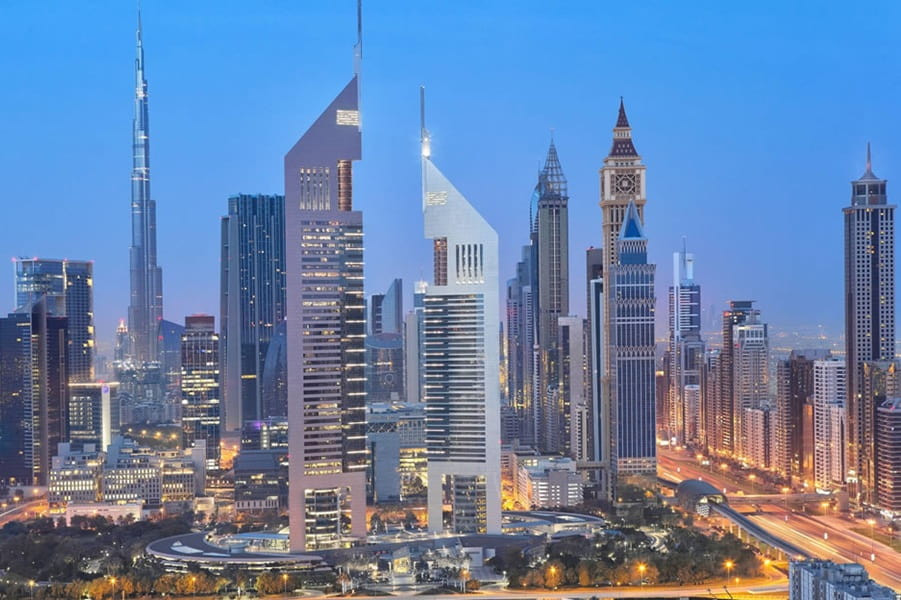
Before the era of megatalls, Emirates Towers were the defining skyscrapers of Dubai’s skyline. This pair of gleaming triangular towers – one an office tower (355 m tall) and one a hotel (309 m tall) – have been an architectural icon since 2000. For a time, these were the tallest buildings in Dubai and the pride of the city, symbolizing Dubai’s emergence as a global business hub. Even today, their distinctive design (sleek glass facades tapering to sharp points) and symmetry make them instantly recognizable amid the skyline.
Location & Significance: The Emirates Towers sit on Sheikh Zayed Road, in the heart of Dubai’s financial district. They’re surrounded by beautifully landscaped gardens and fountains – the complex includes a park-like setting with waterfalls and even resident peacocks roaming the grounds from the nearby royal palace. These towers are so central that they’re often used as a reference point; for example, the Museum of the Future (another new landmark) is just next door, creating a striking contrast of old and new architectural styles. When they opened, the Emirates Towers were celebrated for their modernist design and became a symbol of Dubai (they even appear on local currency notes and many postcards).
Visiting & Activities: The Jumeirah Emirates Towers Hotel (the shorter of the two) is a five-star hotel popular with business travelers and tourists who want a central location. Tourists can visit its lobby and the attached high-end shopping arcade known as The Boulevard, which connects the two towers at the base. Even if you’re not staying there, it’s worth popping in to see the lobby’s atrium and perhaps grab a coffee. The office tower isn’t open to casual visitors, but you can admire it from outside. A unique way to experience the Emirates Towers is by attending events – the hotel’s ballroom and conference centers host exhibitions, fashion shows, and more. Additionally, Dubai’s Museum of the Future, which is a short walk via the Metro footbridge, offers a fantastic photo opportunity: you can capture the curvy sci-fi Museum building with the Emirates Towers rising behind it, encapsulating Dubai’s journey from the past to the future.
For a bit of fun, time your visit around dusk – the towers’ exteriors reflect the sunset, and as night falls, they’re dramatically lit. The view of Emirates Towers from the ground up, with the night sky above, is one of those moments you feel the grandeur of Dubai. If you’re driving (or better, if you rent a car in Dubai for flexibility), a cruise down Sheikh Zayed Road in the evening is breathtaking as you pass these towers and others illuminating the highway.
Investor Insight: While individual investors can’t buy into Emirates Towers (they are owned by the government and Sheikh Mohammed bin Rashid himself), the project has been a proof-of-concept for Dubai’s real estate vision. It demonstrated that high-profile mixed-use developments could thrive in Dubai. The success of Emirates Towers paved the way for later projects like DIFC’s office towers, and even the idea of building hospitality and retail into skyscraper complexes (which is now a common model in Dubai). The hotel tower, with its 400 rooms, continues to have high occupancy and room rates due to its classic reputation and location. For the broader market, Emirates Towers anchored property values in the surrounding area – the condos and offices nearby (e.g., in DIFC or along SZR) have benefited from the landmark effect. So while you can’t buy a piece of Emirates Towers, you can certainly invest in the neighborhood with confidence that these enduring icons will keep the area prestigious. For many Dubai old-timers, the Emirates Towers hold a special sentimental value, representing the city’s first leap into the skyscraper big leagues – and they still inspire awe for newcomers.
JW Marriott Marquis – Sky-High Hospitality in Business Bay
If you thought skyscrapers were only for offices or apartments, think again – Dubai even builds its hotels into the clouds. The JW Marriott Marquis Dubai is a twin-tower complex that reaches 355 m (1,165 ft) high, making it one of the tallest hotel buildings in the world. In fact, when it opened in 2012, it earned the Guinness World Record as the world’s tallest hotel (a title it held until 2018). Comprising two identical towers of 77 floors each, the Marriott Marquis is a feat of engineering dedicated entirely to hospitality – 1,608 guestrooms, numerous restaurants, ballrooms, and a spa, all elevated into the sky.
Location & Design: These twin towers stand in the Business Bay area (just south of Downtown Dubai), adjacent to the Dubai Water Canal. Their design is inspired by the date palm – the cross-section of the towers resembles a palm tree trunk, and the facade features slight fluting. The two towers are connected by a podium and share facilities. When lit up at night with soft white lighting, they are elegant beacons on the skyline. The location is strategic: a short drive from Burj Khalifa and the Dubai Mall, and easily accessible via major roads. From the upper floors and rooftop lounges, guests get dazzling views of Downtown’s skyline to one side and the sprawling cityscape toward the Arabian Gulf on the other.
For Tourists/Guests: Staying at JW Marriott Marquis is a treat for those who want to literally sleep in the clouds. Request a high floor for a room; waking up above the 70th floor with Dubai at your feet is surreal. The hotel’s dining options are also attractions: there’s Prime 68, a steakhouse on the 68th floor, and Vault, a chic bar on the 71st-72nd floors, where you can sip cocktails while enjoying a panoramic city view through floor-to-ceiling windows. Even non-hotel guests often visit Vault for the experience – it’s a great spot to impress a date or simply celebrate a special occasion. The hotel frequently hosts international conferences and celebrity events, so don’t be surprised if you bump into business moguls or entertainers in the lobby. If you’re doing a city sightseeing tour, you’ll likely pass by these towers; they’re a point of pride for tour guides to mention (“that’s the world’s tallest 5-star hotel…”).
Investor Angle: The JW Marriott Marquis is a showcase of confidence in Dubai’s tourism sector. At a cost of around $500 million to build, it was a bold project, but it has paid off as Dubai’s visitor numbers kept growing. While you can’t buy hotel rooms here as an average investor, the success of this property has encouraged investment in nearby hotels and mixed-use developments. It demonstrated that even in a city of superlatives, a mega-hotel can fill 1,600+ rooms by offering quality and by capitalizing on Dubai’s status as a travel and business hub. The Marriott Marquis also cemented Business Bay as a rising district; since its opening, the area saw a boom in property development (both commercial and residential) with investors citing the presence of a world-class hotel as a value booster. For someone considering buying an apartment in Business Bay, having JW Marriott Marquis and other five-star hotels around is a good sign – it indicates the area is in demand and growing in prestige. In summary, JW Marriott Marquis stands as a towering testament to Dubai’s hospitality prowess, attracting travelers from around the globe and assuring investors that Dubai’s skyline isn’t just for show – it’s an economic engine too.
Tips for Visiting Dubai’s Towers and Beyond
Dubai’s skyscrapers offer incredible experiences, and a bit of preparation will help you make the most of them. Here are some practical tips for travelers (and even investors scouting properties) when exploring the city’s top towers:
- Plan Your Tower Visits & Budget: Many popular towers have observation decks or tours that require tickets (e.g. Burj Khalifa’s decks, or the Inside Burj Al Arab tour). Book in advance if possible, and factor these into your Dubai trip cost planning so you’re not caught off guard. Some experiences are pricey (VIP sky deck tickets can be over AED 700), but there are also free viewpoints around the city. Balance your itinerary with a mix of ticketed attractions and free sights like skyline views from public beaches.
- Timing and Weather: Dubai can be very hot in summer, so schedule outdoor tower-gazing (like walking around Marina or Kite Beach for Burj Al Arab views) for early morning or evening. For observation decks, consider visiting during off-peak hours to avoid crowds – early mornings are calm, while just before sunset offers the best light. Remember that humidity in some months can cause hazy views from high up. During winter’s pleasant weather, rooftop lounges (e.g. in Marriott Marquis or Address Sky View) are delightful spots to enjoy towers with a breeze.
- Respect Local Customs: While Dubai is modern, it’s still part of the UAE with its cultural norms. When visiting towers located in or near residential areas or malls (like Burj Khalifa via Dubai Mall), dress modestly and act respectfully. Avoid public displays of affection and always ask for permission before photographing people. Familiarize yourself with basic Do’s and Don’ts When Traveling to Dubai – for example, do handle yourself courteously in public and don’t drink alcohol outside licensed venues. By being mindful of local etiquette, you’ll have a smoother experience moving around famous sites without unintentionally offending anyone.
- Getting Around: Dubai’s towers are spread across different neighborhoods – Downtown, Marina, Palm Jumeirah, etc. The city does have a metro (which is great for Burj Khalifa and Emirates Towers), but to reach others like those in the Marina or the Palm, you might want flexible transport. It’s easy to rent a car in Dubai the roads are well-developed and attractions well-signposted. Having your own car (or hiring a driver) lets you hop between far-flung spots on your own schedule. Services like Drivex Dubai Marina specialize in visitor car rentals right in the Marina district, which is convenient if you’re staying there and want to drive out to, say, the Dubai Creek area or Abu Dhabi for a day. If driving isn’t for you, taxis and ride-hailing apps are plentiful and reasonably priced for shorter hops.
- Vantage Points & Photography: To capture these towers in all their glory, scope out the best vantage points. For Burj Khalifa, try the plaza by Dubai Opera or the bridge to Souk Al Bahar – you’ll get the tower with the fountain lake in front. For Cayan Tower and Marina’s skyline, the Dubai Marina Harbour (near the Lighthouse tower) gives a panoramic shot. Sunrise or sunset are magical times for photos, with softer light and often vibrant skies. Also, consider visiting Dubai Frame (an attraction shaped like a giant frame) which isn’t a skyscraper per se, but from its observation bridge you get one of the coolest views: the old city on one side and the modern towers on the other – a living “before and after” of Dubai.
Finally, whether you’re a tourist ticking off landmarks or an investor evaluating properties, take the time to soak in the atmosphere around these towers. Grab a coffee at a cafe in Downtown and watch how Burj Khalifa literally disappears into the clouds on some mornings, or walk along the Marina promenade at night with skyscrapers sparkling above you. These moments truly capture the spirit of Dubai – a city that tenaciously reaches for the sky. Enjoy your tower-hopping adventure, and don’t forget to look up! Each structure has a story to tell in the larger narrative of Dubai’s rise, and now you’re part of that story as you explore them.